When Your Pool Passes the Obvious Tests — But Still Loses Water
One of the most frustrating experiences for a Pasadena pool owner is watching the water level drop week after week despite finding no obvious crack in the plaster and no wet soil around the equipment pad. In many of these cases, the leak isn't in the shell or the underground plumbing at all — it's hiding in plain sight at the pool's light niche or at the jet fittings in an attached spa.
Bell Brothers Pasadena Pool Leak Detection uses targeted dye testing to isolate leaks at exactly these kinds of hard-to-find locations. Our pool light and niche leak repair and spa and hot tub leak detection services are specifically designed for the failure points that standard visual inspections miss most often.
How Pool Light Niches Leak — and Why They're Easy to Miss
Every in-ground pool with an underwater light has a niche: a recessed housing embedded in the pool wall that holds the light fixture. The niche is penetrated by a conduit carrying the electrical cable. There are three places this assembly can develop a leak:
- The face ring gasket: The rubber gasket between the chrome or plastic face ring and the niche face compresses and seals the joint when the light is tightened in place. Over time — accelerated by UV exposure, pool chemicals, and thermal cycling — this gasket hardens, shrinks, and loses its sealing ability. A deteriorated gasket allows pool water to flow past the seal and into the wall cavity behind the niche, routing away from the pool without ever appearing on the surface deck.
- The conduit penetration: The conduit carrying the electrical cable exits the back of the niche and enters the surrounding gunite. If the sealant at this penetration fails — as it commonly does after 10 to 15 years — water travels down the conduit pathway and into the surrounding soil. This type of leak can be particularly deceptive because the water exit point is far removed from any visible surface.
- The niche body itself: In older pools, the plastic or fiberglass niche housing can develop a crack, particularly at the corners or along the back face. A cracked niche body is typically treated with an epoxy compound rated for continuous water immersion.
The reason these leaks are so easy to miss is that the water leaving through a compromised niche doesn't pool on the deck surface or create a visible wet spot in a predictable location — it disperses into the soil behind the pool wall. A pool can lose a significant amount of water through a failing light niche seal for months before the homeowner connects the water loss to the light fixture.
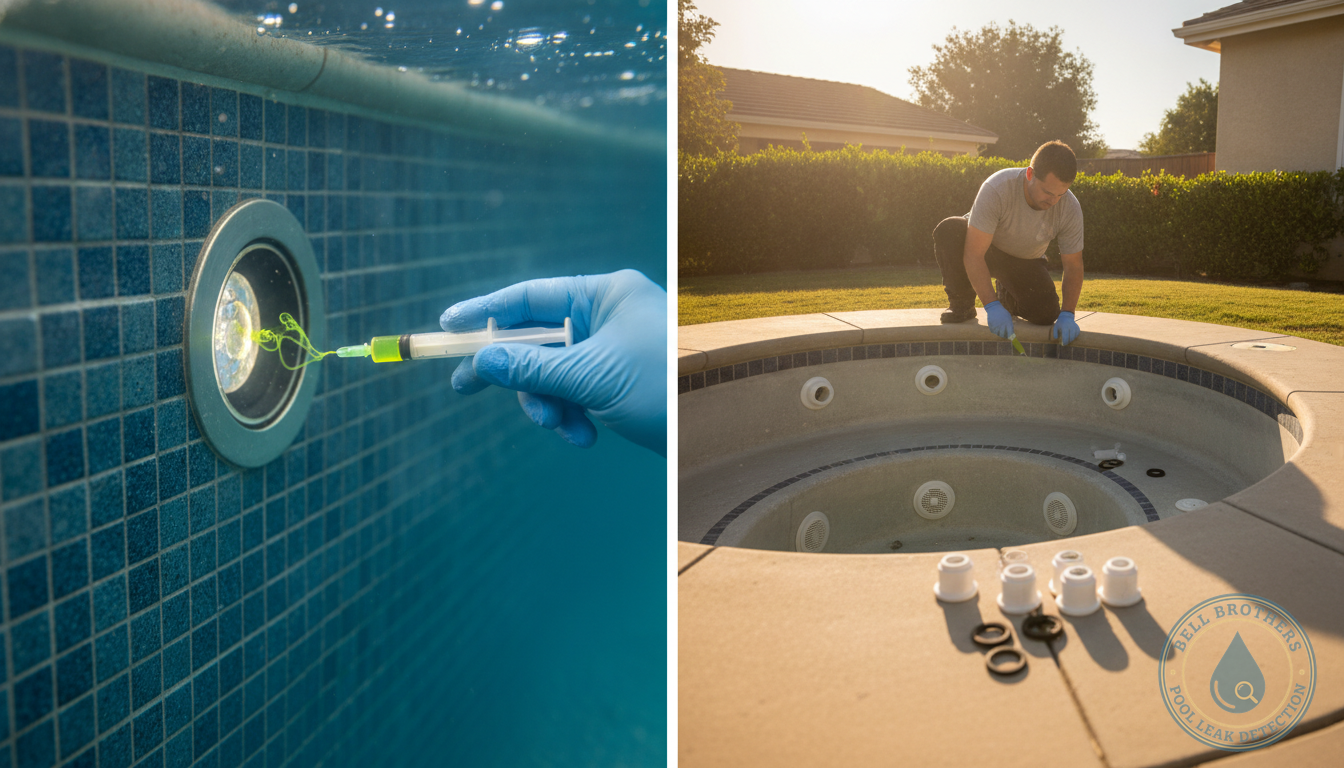
Our dye testing process resolves this uncertainty immediately. With the pool water still, our technician positions a dye syringe near the face ring gasket and the conduit entry point. If the seal is compromised, the dye is visibly drawn into the gap, confirming the niche as the leak source. If the dye disperses evenly without being drawn in, we move on to the next potential leak point.
Spa Jet Fittings: More Connections, More Opportunities to Leak
Attached spas and freestanding hot tubs contain significantly more plumbing fittings per square foot than a standard pool. A typical spa with 8 to 12 jets also has an air induction blower line, a dedicated suction drain, and in many cases a shared spillway connecting to the adjacent pool. Every one of these connection points is a potential leak source.
Spa jet bodies are particularly prone to failure for several reasons specific to spa operation:
- Heat cycling: Spa water is typically maintained between 100°F and 104°F. The repeated thermal expansion and contraction of plastic fittings and rubber gaskets at these temperatures is far more aggressive than anything a pool fitting experiences, and it accelerates gasket hardening and plastic thread cracking.
- Chemical concentration: Because spas hold a much smaller volume of water than pools, sanitizer and pH adjusters are more concentrated relative to water volume. This accelerated chemical environment degrades gaskets and plastic components faster than in pool plumbing.
- Torque stress on threaded fittings: Jet bodies are threaded into wall fittings and tightened by hand. Over time, thermal cycling causes these threaded connections to work loose, and retightening them can crack the plastic wall fitting itself.
Our spa leak detection process tests each jet body, air fitting, and plumbing circuit individually, so we know exactly which component is losing water before any work begins. For attached spas, we also evaluate the bond beam — the shared structural element between the spa shell and the pool — which can crack under the combined thermal and structural stress of two adjacent water bodies.
What a Spa Leak Repair Actually Involves
The appropriate repair depends on what the dye test reveals:
- Failed jet body gasket: In many cases the jet insert and its internal gasket can be replaced without removing the wall fitting from the spa shell, provided the wall fitting itself is structurally intact. The water level is lowered below the jet, the insert is removed, a new gasket is installed, and the insert is reseated and torqued to spec.
- Cracked wall fitting: A cracked wall fitting requires the spa to be partially or fully drained and the fitting to be cut out and replaced. The surrounding plaster or shell material is then patched and finished to match.
- Bond beam crack: Bond beam cracks are treated similarly to other structural shell cracks — the crack is chased out, filled with a flexible polyurethane or epoxy compound, and the surface is refinished. The flexibility of the filler material is important in a bond beam application because the interface between two water bodies continues to experience thermal movement throughout the life of the pool.
Serving Pasadena's Spa-Owning Communities
Many of the communities Bell Brothers serves — including San Marino, La Cañada Flintridge, and Altadena — feature luxury properties where an attached spa is as important to the homeowner as the pool itself. We understand that a spa losing water overnight isn't just a nuisance — in a high-end property, it represents a service call that needs to be handled with care, efficiency, and minimal disruption to the surrounding landscape.
If your spa requires daily topping off, or if your Pasadena pool light area shows staining, efflorescence, or discoloration around the niche face, don't wait for the problem to get larger. Call Bell Brothers at +1 (626) 899-9835 or email [email protected] to book a dye-test-based inspection. We serve the full Pasadena area Monday through Sunday, 8:00 AM to 6:00 PM, and we document every finding in writing before any repair work begins.