The Hidden Problem Beneath Your Pool Deck
Most Pasadena pool owners think of leaks as something visible — a crack in the plaster or a dripping fitting at the equipment pad. But a significant portion of pool water loss originates underground, in the network of PVC pipes that carry water from the pool to the pump, filter, heater, and back again. Because these pipes are buried beneath concrete decks, landscaping, and soil, a plumbing leak can lose thousands of gallons of water before a homeowner notices anything at all.
Bell Brothers Pasadena Pool Leak Detection specializes in pool plumbing leak detection using hydraulic pressure testing to isolate leaking lines without unnecessary excavation. Understanding why underground plumbing fails — and how we find it — can help you protect your investment and avoid a costly surprise.
Why Pool Plumbing Fails in the Pasadena Area
Pasadena and the surrounding San Gabriel Valley present several specific conditions that accelerate pool plumbing failures:
- Seasonal soil movement: Southern California's wet winters and dry summers cause significant soil expansion and contraction throughout the year. PVC pipes buried in expansive clay soil flex with every season, and over time the stress concentrates at fittings, elbows, and union connections where the pipe has less flexibility. The hillside properties around the Arroyo Seco corridor are particularly susceptible to this type of ground-shift damage.
- Seismic activity: Even minor seismic events can shift underground plumbing laterally, stressing glued joint connections and causing slow leaks at elbows or tee fittings deep beneath the deck.
- Mature tree root systems: Many of Pasadena's older neighborhoods feature large, established trees whose root systems extend far into the surrounding soil. Roots seeking moisture will find and infiltrate small cracks in PVC plumbing, enlarging them over time. Bungalow Heaven and other historic Pasadena neighborhoods with mature street trees are especially prone to this problem.
- Aging PVC: Pool plumbing installed in the 1980s and 1990s is now 30 to 40 years old. PVC becomes brittle with age and prolonged exposure to pool chemicals, and older pipe formulations do not have the impact resistance of modern materials.
How Hydraulic Pressure Testing Works
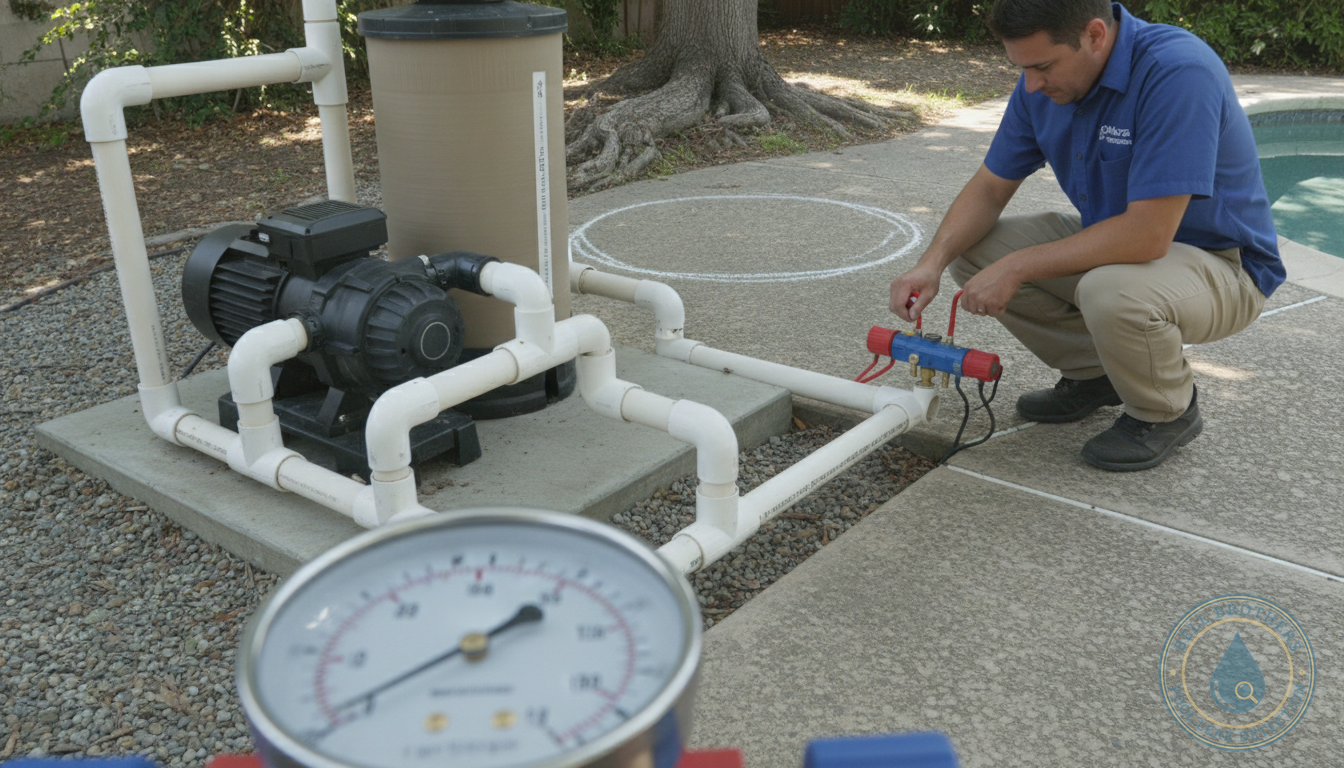
The cornerstone of our pool plumbing leak detection process is hydraulic pressure testing performed on individual plumbing circuits. Here's how it works in practice:
Our technician begins by isolating each circuit — return lines, suction lines, and any dedicated spa or water feature lines — using rubber expansion plugs inserted at the pool end of the pipe. The circuit is then pressurized with water to a test pressure and monitored. A line that holds pressure is not leaking; a line that loses pressure has a breach somewhere along its run. By testing circuits one at a time rather than pressurizing the entire plumbing system at once, we can identify exactly which line is failing before anyone picks up a shovel.
Once we know which line is leaking, we use acoustic listening equipment — a sensitive microphone pressed against the deck surface — to detect the sound of water escaping under pressure. This acoustic locating process can pinpoint the leak location within a foot or two, dramatically reducing the area of concrete that needs to be cut for repair access.
Common Plumbing Leak Locations We Find
- Union fittings at the equipment pad: The unions that connect underground plumbing to the pump and filter are among the highest-stress connection points in the system. O-rings in these unions degrade over time and allow water to escape, often appearing as a wet stain around the base of the equipment pad.
- Lateral pipe runs beneath the deck: The long horizontal pipe runs beneath the pool deck are vulnerable to ground movement stress. Cracks typically appear at midpoint on long runs or at changes in direction.
- Skimmer throat connections: The transition point where underground suction plumbing connects to the skimmer body is a common failure point, especially in older pools. Our skimmer and return fitting leak repair service addresses this specific area.
- Return jet fittings at the pool wall: The threaded wall fittings that anchor return jets can loosen or crack, allowing water to escape behind the pool shell rather than into the pool.
Serving Pasadena and the Greater San Gabriel Valley
Bell Brothers provides pool plumbing leak detection throughout Pasadena and nearby communities. If you're in Alhambra, San Gabriel, or Sierra Madre, our technicians are familiar with the local soil conditions and pool construction history that affect plumbing reliability in each area.
Don't wait for a leaking underground line to erode the soil beneath your pool deck or wash out the foundation of your equipment pad. Call Bell Brothers at +1 (626) 899-9835 or email [email protected] to schedule a pressure test. We document all results in writing so you have a clear picture of your pool's plumbing health before any repair decisions are made.